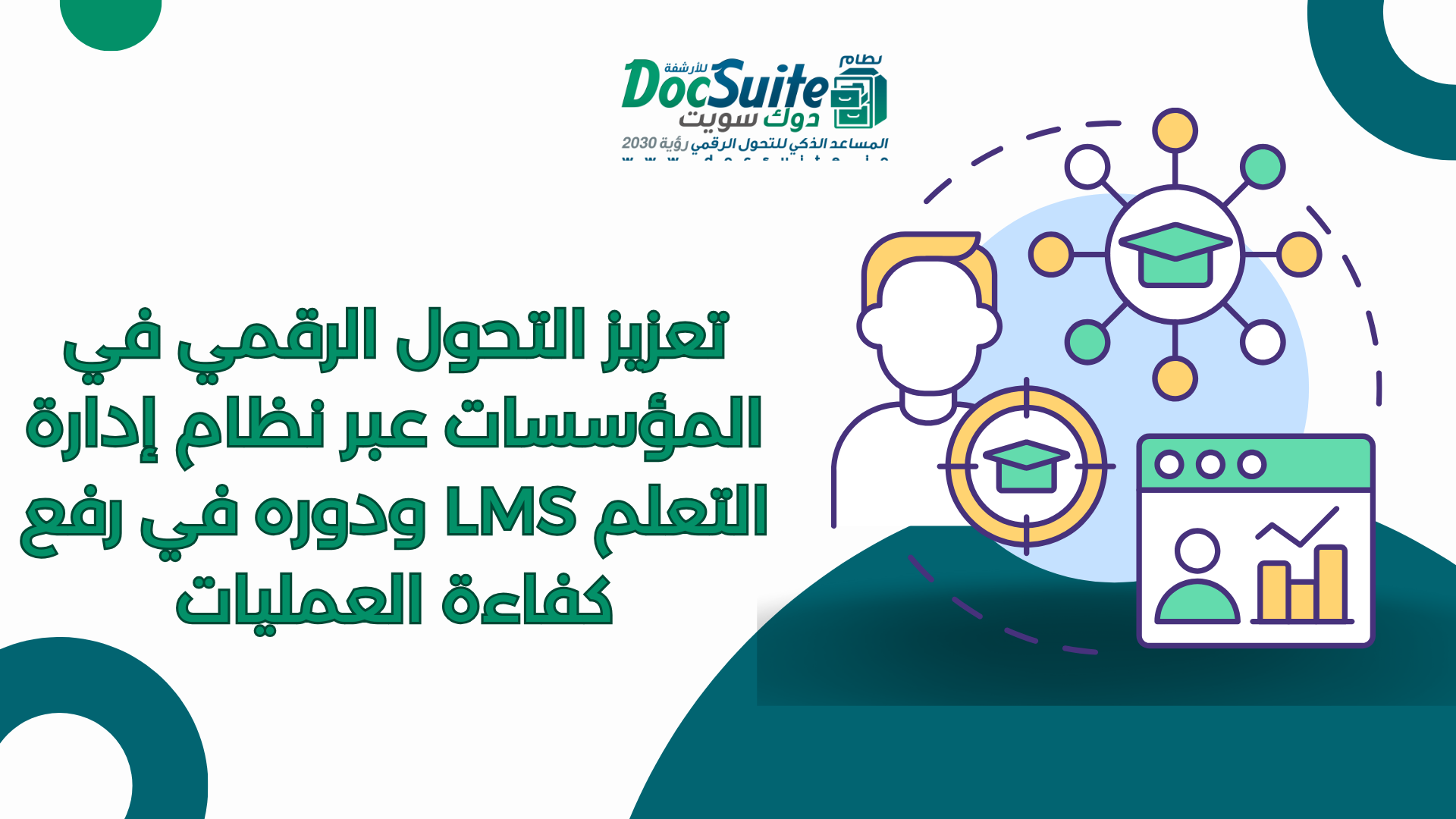
Learning Management SystemLMS is one of the most important drivers of development in modern educational and training institutions, as it contributes to transforming traditional learning methods into a comprehensive digital system, and enhances the efficiency of employees and learners. It also flexibly aligns with smart administrative systems that invest technology in improving the quality of performance, such as the "DocSuite HR" system, which supports the transition from paper-based management to fully electronic management.
In this article, we review the role of the Learning Management System.LMS in organizational development, and we highlight the importance of its integration with modern systems to ensure higher efficiency and broader productivity.
Enhancing the role of the learning management systemLMS in developing contemporary digital learning environments
Bringing about a qualitative shift in educational environments has become essential in light of the digital revolution, and that is why the Learning Management System (LMS) was developed.LMS reshapes the educational process at the design, implementation, and evaluation levels, enabling educational and training institutions to provide a flexible environment that can accommodate thousands of learners without the need for complex infrastructure.
The learning management system contributesThe LMS integrates artificial intelligence technologies and advanced data analytics, making the learning experience more personalized and adaptable to each learner's needs. The LMS also organizes and makes educational content available anytime, anywhere, increasing the speed of access to knowledge and providing learners with opportunities for continuous interaction.
The value of a learning management system is multipliedWhen an LMS is linked with smart management systems such as DocSuite HR, which supports electronic document management and the organization of institutional procedures through advanced technologies, it gives educational institutions an ideal model for transitioning from traditional management to fully digital management.
As educational institutions continue to expand, having a system that combines content management, process documentation, and data collection becomes essential to ensure operational efficiency.The LMS plays this vital role, while indirect integration with systems such as DocSuite HR enhances the ability of organizations to manage educational and administrative files more flexibly, leading to increased productivity and improved quality of learning services.
Improving the quality of institutional training through a learning management systemLMS in corporate environments
Improving the quality of training within institutions is no longer a secondary option but has become a strategic necessity due to increasing competition in the labor market. Therefore, the Learning Management System (LMS) offers...LMS is an integrated framework that makes it easier for companies to design professional training programs that keep pace with rapid developments in the fields of work. The system helps managers to continuously monitor employee performance and identify strengths and weaknesses based on accurate data.
The learning management system is characterized byThe LMS's ability to standardize training and reduce costs stems from its reliance on continuously updated digital content. Organizations benefit from the system's intelligent assessment tools, which help analyze employee development levels and measure training quality more accurately than traditional methods.
In this context, the concept of a learning management system is integrated.LMS, along with other corporate systems that rely on digital transformation, such as DocSuite HR, organizes administrative processes, automates procedures and internal communications, making the work environment more organized and therefore more ready to benefit from e-training.
The indirect integration between the learning management systemLMS and management automation systems provide access to training content and link its results to employee records, creating an integrated system that provides a comprehensive picture of workforce performance.
Through this methodology, organizations can accurately identify future training needs and ensure that all employees receive high-quality training content that supports their career development and is reflected in the organization's productivity.
Achieving digital integration between the learning management systemLMS and Smart Management Systems
Achieving integration between the learning management systemLMS and modern management systems have become a strategic step relied upon by institutions seeking to raise efficiency and unify data, as this integration leads to reducing duplication of work, accelerating the transfer of information between different departments, and making processes smoother and more harmonious.
The integration between the learning management systemLMS and automated management systems such as DocSuite HR manage documents and processes related to learning and development on a unified platform, saving time, reducing errors and ensuring data accuracy.
DocSuite dependsHR is based on an advanced technological infrastructure that allows for the conversion of paper documents into an integrated electronic management system, creating an ideal environment for linking training data to employee files.
When systems work together, organizations can track learning pathways and align them with the skills actually needed in the job market. This integration also facilitates automated and efficient reporting, record updating, progress tracking, and the application of total quality management standards.
This integration enhances the ability to make strategic decisions such as identifying performance gaps, developing targeted training plans, and improving internal communication by making information available in one place. With the rapid development of digital technologies, this integration is not just an added advantage, but a fundamental requirement to ensure that organizations can compete and be sustainable.
Clarifying the following practical aspects helps organizations understand the precise benefits offered by a learning management system.When integrated into the corporate work system, the points reflect the most prominent advantages that achieve higher efficiency and support comprehensive digital transformation.
- Advantages of using a Learning Management SystemLMS within organizations
- Enhancing the accessibility of educational content.
- Accelerating monitoring and evaluation processes.
- Reducing the costs of paper-based training.
- Supporting employee development plans.
- Linking training to digital management methodologies.
- Explaining the importance of integration betweenLMS and Enterprise Automation Systems
- Unifying databases across departments.
- Faster approvals and automated procedures.
- Making accurate, data-driven decisions.
- Improving employee experience through a unified environment.
- Achieving a real transition towards paperless management.
- Highlighting the role of artificial intelligence in developmentLMS
- The content is tailored to each trainee according to their level.
- Monitoring the interaction in real time.
- Increase the level of data protection.
- Predicting future training needs.
- Improving content quality using smart analytics.
Enhancing organizational efficiency through the integration of a learning management systemLMS in a comprehensive digital transformation strategy
Establishing the foundations for digital transformation within institutions requires an interconnected technological infrastructure that integrates education and development on one hand, and management and organization on the other. Therefore, the learning management system is gaining importance.LMS is of increasing importance as one of the key pillars in building an integrated system that takes advantage of modern technologies to enhance performance and maximize productivity.
When organizations work on integrating a learning management systemAs part of its digital strategy, LMS not only provides electronic training content, but also builds a collaborative environment in which performance can be accurately tracked, employee needs can be studied, and their skills can be continuously developed. All of this is reflected in improving the quality of the human resources sector.
From this perspective, indirect integration with business automation systems such as DocSuite becomes possible.HR is a pivotal factor; it contributes to organizing documents and procedures and linking administrative data with training results, giving management a clearer view of employee efficiency and implemented programs, and helping it to make strategic decisions based on realistic data.
As organizations expand in size and increase in the number of their employees, the need arises for a system capable of handling large amounts of information without it getting lost among paper files or separate databases, which is what [the system] offers.LMS by standardizing training data, making it more accessible, and enabling its use by different departments.
It also offers additional features such as managing training schedules, analyzing learning patterns, and providing comprehensive reports that help in understanding learners' behavioral trends. When these capabilities are combined with the advanced features of electronic management systems such as DocSuite, they can be even more effective.HR makes it possible to achieve a comprehensive digital transformation that links knowledge, performance, and productivity, making the organization more competitive and future-ready.
We now realize that organizations seeking to build a more efficient and sustainable future cannot ignore the pivotal role played by a learning management system.LMS is reshaping the methods of education, training, and human resource development. With the rapid expansion of information volume and changing labor market requirements, the Learning Management System (LMS) is no longer just an e-learning platform, but a strategic system that combines knowledge management, intelligent data analysis, and content personalization, creating a sophisticated environment capable of supporting the organization’s short-term and long-term goals.